
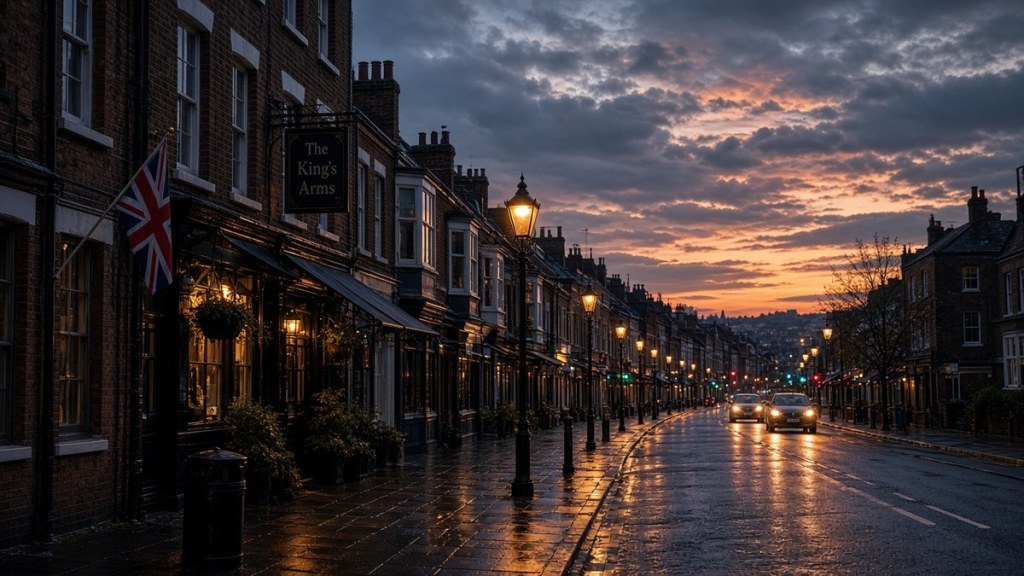
There is a particular Monday every year, and you probably know the one I mean. You leave work at the usual time, step outside, and the day has already gone. The streetlights are on. The car park is dark. It is as if somebody has quietly taken an hour of afternoon from you, and the evening that used to stretch out ahead now feels like the start of the night.
In the UK, that Monday falls on 26 October this year. The clocks go back at 2am on Sunday 25 October, when British Summer Time ends and we return to Greenwich Mean Time. You get an extra hour in bed on Sunday morning. What you lose is light at the end of the day, and for a lot of us that loss lands harder than an hour on a clock ought to.
So if you notice your mood dipping as the evenings close in, you are not imagining it, and you are not being weak. There is research on exactly this moment, and there are small things you can do in the days before 25 October to make the darker months easier to walk into.
For me, it is that first evening when I look up and realise the light has gone without my noticing. There is a small, quiet sadness in it, like saying goodbye to something I had not quite finished enjoying.
What one large study found about this exact weekend
In 2017, a team of Danish researchers, with Bertel Hansen as lead author, published a study in the journal Epidemiology on what happens to depression around the clock changes. They used Denmark’s national psychiatric register and examined 185,419 hospital contacts for depression between 1995 and 2012.
They found that after the switch from summer time to standard time, the kind of change we make on 25 October, the rate of new depressive episodes diagnosed at acute psychiatric hospital contacts in Denmark rose by about 11 per cent. That rise faded over roughly ten weeks. The spring change, when the clocks go forward, showed no similar effect.
The authors suggest the reason may be the sudden shift to earlier sunsets: it marks the start of a long stretch of short days, and that signal can be hard to take. The total amount of daylight on the Monday is almost the same as on the Saturday. What changes is when you get it, and what that tells you about the months ahead.
Think of it this way: the clock change is less the cause of winter low mood than a door closing. The season was already turning; the clocks just make you hear it.
Low mood, the winter blues, or something more?
Most of us feel some pull towards the sofa as autumn deepens. Slower mornings, an appetite for heavier food, less appetite for going out. That is a normal response to the season, and it does not need a label.
For some people it goes further. The NHS describes seasonal affective disorder (SAD) as a type of depression that usually happens in winter and eases in summer. The symptoms it lists include low mood, losing interest in things you usually enjoy, feeling guilty, hopeless or worthless, feeling restless or irritable, finding it hard to concentrate, feeling hungrier and eating more than usual, and feeling more tired and sleeping more than usual. Some people have thoughts of not wanting to be here. If that is you, there are people you can talk to right now, listed at the end of this piece.
The NHS is candid that the exact cause is not known. The main idea is that reduced daylight may change brain chemicals such as melatonin and serotonin, which affect your mood, your sleep and your body’s internal clock.
Two things can be true at once. Autumn can be a natural slowing down that asks nothing of you but a bit more rest. And for some people, the same season tips into a depression that deserves proper care. The difference is not how dark it is outside. It is how much the low mood is taking from your life, and for how long.
What the evidence says about light
Light therapy (sitting in front of a bright lamp for a set time each day) is the treatment most people have heard of. The evidence for it is real but more modest than the adverts suggest.
In 2020, Edda Pjrek and colleagues at the Medical University of Vienna published a meta-analysis in Psychotherapy and Psychosomatics that brought together 19 randomised controlled trials comparing bright light therapy with a placebo condition in adults with SAD. Light therapy reduced depression scores, with a small-to-moderate effect (standardised mean difference −0.37), and people using it were about 1.4 times as likely to respond to treatment.
The authors were clear about the limits: the trials varied in how they were run, were mostly small to medium in size, and carried a moderate-to-high risk of bias. Their conclusion was that light therapy can be regarded as effective, but that larger, better-quality trials are needed.
The NHS is more cautious. It notes that light therapy is not usually available on the NHS because there is not enough evidence to tell whether it is effective, though many people find it helps. If you are thinking of trying it, the NHS advises speaking to a GP first, as it may not suit you if you have certain eye conditions or take some medicines that make you more sensitive to light. If you do buy a lamp, make sure it is bright enough (10,000 lux is standard), UV-free and carries a UKCA or CE mark.
The NHS also recommends talking therapies such as cognitive behavioural therapy (CBT) for SAD, and antidepressants for some people. Many people need treatment every winter to stop the symptoms coming back.
What this research cannot tell you
Before you lean on any of this, a few honest limits.
The Danish study is large, but it counted hospital diagnoses, which means people whose depression was serious enough to reach a hospital in Denmark. It shows a rise across a population; it cannot tell you whether the clock change will affect you. It is also observational, so it shows a pattern rather than proving the clock change caused any one person’s depression. And Denmark sits further north than where most of us in the UK live, so the seasonal swing in daylight is larger there.
The light therapy meta-analysis pooled varied trials, and the authors themselves rated the risk of bias as moderate to high. A lamp is not a guaranteed fix, and it is not a substitute for talking to someone if your mood is sliding.
The NHS guidance describes common patterns. It cannot diagnose you. Only a conversation with your GP or a clinician can do that.
None of this makes the picture false. It means the darker months are a known pressure point, the tools are worth trying, and none of them is magic.
Preparing your mind: what to do before and after 25 October
The useful thing about the clock change is that you know exactly when it is coming. You do not have to wait for the first dark Monday to start getting ready.
Before 25 October
Get into daylight, starting in the morning. The NHS self-help advice for SAD begins with natural light: get as much as you can, and try to go outside in the daytime every day. A ten-minute walk before work counts. So does a coffee by the window instead of at the back of the kitchen.
Fix your waking time and protect it. The NHS recommends going to bed and waking up at the same time every day. Over the clock-change weekend, try to wake at your usual clock time on the Sunday rather than banking the extra hour. Your body tends to settle faster when that anchor stays put.
Write down your early warning signs now, while you feel all right. Two or three lines on your phone: what you tend to notice first when your mood starts to drop. Sleeping later. Cancelling plans. Snapping at people you love. It is much easier to spot a pattern you have already named.
After the clocks change
Put something in the evenings on purpose. When it is dark at five, the evening can feel finished before it has started. Book one fixed thing each week, such as a phone call, a class, a walk with a friend or a family meal, so the evenings have a shape. The NHS lists keeping in touch with people among its self-help steps, and for good reason.
Move, ideally in daylight. Regular exercise is on the NHS list too. A lunchtime walk gives you movement and light in one go.
Do the thing before you feel like it. Low mood tells you to wait until you have the energy. Often it works the other way round: the small action comes first, and the feeling follows. Pick one task you would normally enjoy and do a short version of it, even if your heart is not in it yet.
Go easy on the props. The NHS suggests not drinking too much alcohol and not using phones and other screens right before bed. Both are tempting on long dark evenings, and both tend to make sleep, and then mood, worse.
What helps me most is a slow start: a cup of tea by the window in the first light, and a short walk before the day gets busy. It is a small thing, but it reminds me the light is still there, just at a different time of day.
When to get help
If your mood stays low for more than a couple of weeks, if it is affecting work, sleep or relationships, or if the same pattern comes back every winter, it is worth talking to your GP. You do not need to wait until it is unbearable. In England you can also refer yourself to NHS Talking Therapies for problems such as depression and anxiety without seeing a GP first, as long as you are registered with a GP and aged 18 or over (16 in some areas).
You are the sky, not the weather
The clocks will go back on 25 October whether you are ready or not. But you get to decide what the days before it look like. Morning light. A steady wake-up time. A few lines naming your early warning signs. One thing in the diary for those first dark evenings.
None of that stops winter coming. It changes how you meet it. Low mood can roll in like weather, grey and heavy, and it can stay for a while. But you are the sky it moves across, not the weather itself. The darkness is a season. It is not a verdict on you, and it is not permanent.
So why wait for the dark to arrive before you prepare for it? Here is one small thing to do this week: open the notes app on your phone, write down the three signs that tell you your mood is slipping, and set a reminder for the morning of Monday 26 October to read them back. You are getting ready now, while you still have the light.
If you need someone now
If you are struggling and need to talk to someone straight away, you can call Samaritans free on 116 123, 24 hours a day, 7 days a week, from anywhere in the UK and the Republic of Ireland. You do not have to be in crisis to call. More at samaritans.org.
If you need help but it is not an emergency, contact NHS 111 or your GP. If anyone is in immediate danger, call 999.
This article is for general information and is not a substitute for advice from your GP or a qualified clinician.
Sources
- Royal Museums Greenwich. “When do the clocks go back?” (2026: Sunday 25 October, 2am). rmg.co.uk
- Hansen, B. T., Sønderskov, K. M., Hageman, I., Dinesen, P. T., & Østergaard, S. D. (2017). Daylight savings time transitions and the incidence rate of unipolar depressive episodes. Epidemiology, 28(3), 346–353. https://doi.org/10.1097/EDE.0000000000000580
- NHS. “Seasonal affective disorder (SAD).” nhs.uk
- Pjrek, E., Friedrich, M.-E., Cambioli, L., Dold, M., Jäger, F., Komorowski, A., Lanzenberger, R., Kasper, S., & Winkler, D. (2020). The efficacy of light therapy in the treatment of seasonal affective disorder: a meta-analysis of randomized controlled trials. Psychotherapy and Psychosomatics, 89(1), 17–24. https://doi.org/10.1159/000502891
- NHS. “Talking therapies.” nhs.uk
- Samaritans. “Contact a Samaritan.” samaritans.org


Leave a Reply